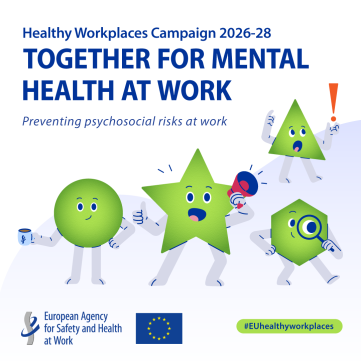
The European Federation of Psychologists’ Associations (EFPA) is proud to be a partner of the European Agency for Safety and Health at Work (EU-OSHA)’s Healthy Workplaces Campaign 2026–2028, “Together for Mental Health at Work”, launched in Brussels on 13 October 2026.
The campaign brings together stakeholders from across Europe to promote mental health in the workplace, strengthen prevention and share practical solutions that respond to the diverse needs of workers, sectors and national contexts.
Through its contribution to the campaign, EFPA will seek to connect psychological knowledge with practical action, highlighting relevant evidence and experiences from across its European network. The aim is to help ensure that psychological science informs workplace mental health initiatives and that effective practices can be shared and adapted across different national and organisational contexts.
EFPA welcomes this opportunity to work alongside EU-OSHA and fellow campaign partners to advance a shared commitment: making mental health an integral part of healthy, safe and sustainable workplaces across Europe.
A particular focus will be the opportunities and challenges of digitalisation for mental health in the workplace. Digital technologies can support accessibility, flexibility and worker well-being, but they can also introduce risks related to psychosocial working conditions, digital exclusion, work intensity and the boundaries between professional and personal life. Understanding these impacts is essential to ensuring that digital transformation supports, rather than undermines, mental health.
EFPA’s work on digitalisation is guided by six principles:
- Co-Production of Regulation;
- People-Centred Development;
- Transparent & Controllable;
- Digital Literacy & Accessibility;
- Navigable Digital Determinants;
- and Enhance Not Replace.
These principles provide a framework for considering how digital technologies can be designed and implemented in ways that respect people’s needs, support meaningful participation and promote well-being.