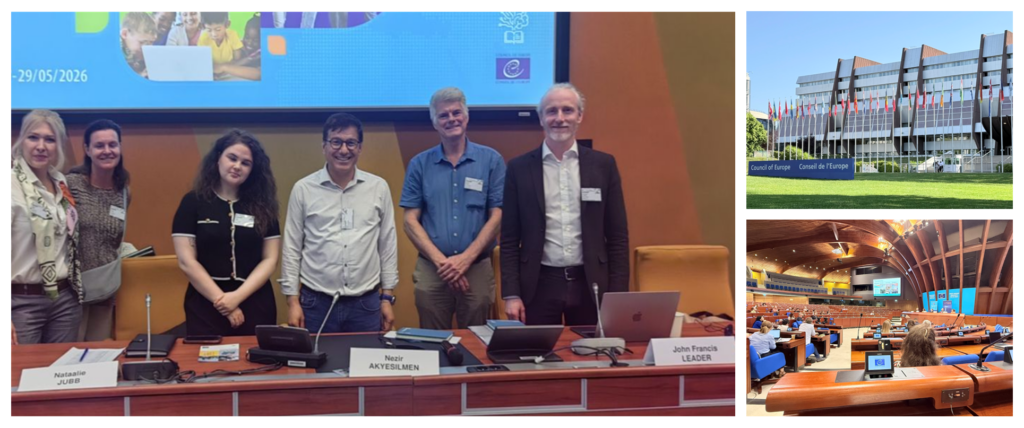
May 2026, Strasbourg, France – The European Federation of Psychologists’ Associations (EFPA) participated in the Second European Forum on Digital Citizenship Education (DCE), convened by the Council of Europe in Strasbourg from 27–29 May 2026. The Forum brought together representatives from governments, education systems, civil society organisations, youth groups, and professional bodies from across Europe to advance a shared vision for responsible and inclusive participation in digital environments. The event focused on key challenges and opportunities arising from rapid technological change, including artificial intelligence, online safety, media literacy, and democratic engagement in digital spaces.
EFPA moderated and contributed psychological expertise to discussions on the human impact of digital technologies and the skills citizens need to thrive in an increasingly digital society. EFPA highlighted the vital role of psychology in supporting digital wellbeing, critical thinking, strengthening resilience against misinformation, and promoting healthy online behaviours among children, young people, and adults. The Federation emphasised that digital citizenship must be grounded in psychological science and a commitment to inclusive participation.
This participation comes as the psychological impact of technology increasingly features in European policy, with an emphasis on how to balance the benefits and risks of digital engagement. President von der Leyen, speaking in May at the European Summit on Artificial Intelligence and Children, noted both aspects: “We all recognise the extraordinary opportunities this technological revolution brings. Many young people, when you listen to them, speak passionately of how technology gives them a sense of belonging”, while also noting that “Their minds are delicate, their psychological vulnerability profound”.
EFPA welcomes President von der Leyen’s attention to the psychological aspects of technology governance. EFPA’s engagement reflects its ongoing commitment to people-centred digital development and responsible innovation. Through its digitalisation work, EFPA advocates for the integration of psychological knowledge into the design, regulation, and deployment of emerging technologies, ensuring that technological advancement supports individual wellbeing and social cohesion. The Council of Europe’s Digital Citizenship Education Forum provides an important opportunity to collaborate with policymakers, educators, and civil society partners on shaping future European priorities for digital citizenship education.
Villano Qiriazi, Head of the Education Department at the Council of Europe, in summarising the conclusions of the Digital Citizenship Forum noted that: digital and physical realities can no longer be understood as separate, as our online and offline lives are deeply interconnected. In this context, human agency and rights must remain at the centre of all approaches to DCE. Wellbeing should be recognised as a core theme rather than a peripheral concern, with particular attention given to both physical and mental health. At the same time, DCE cannot be delivered through schools alone; it requires a broader, intergenerational approach that supports learning across families, communities, and society as a whole. Finally, meaningful cooperation is essential, with young people placed firmly at the centre of dialogue, decision-making, and the development of solutions.
EFPA is supporting the development of the Council of Europe’s Road Map for Strengthening Digital Citizenship Education 2027–2031, which was a central focus of the Forum. The Federation remains committed to working alongside the Council of Europe and a broad range of stakeholders to ensure that psychological perspectives contribute to building a digital future that promotes active participation, protects wellbeing, and empowers all citizens to engage responsibly and confidently with digital technologies.